What Makes Nurrow a Gamified Productivity App (Not Just a Timer With a Mascot)
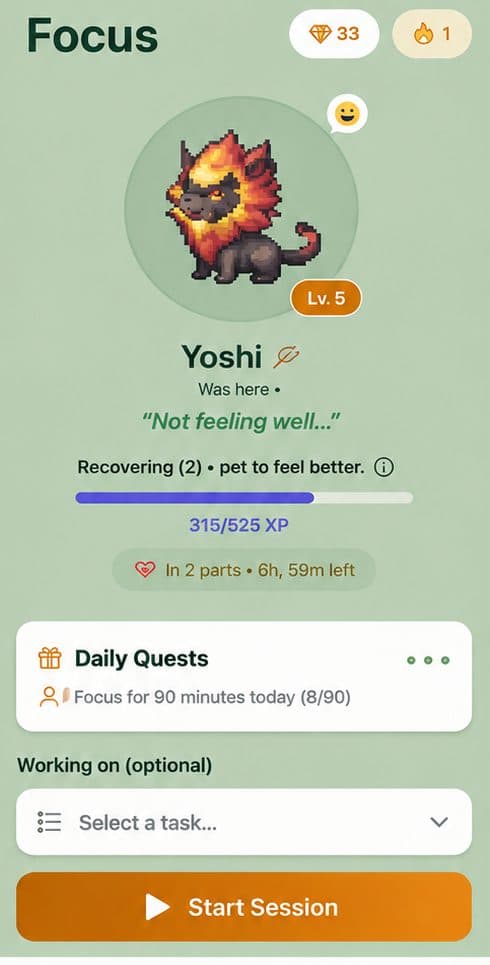
Plenty of apps bolt a cartoon character onto a timer and call it gamified. Nurrow works differently: eggs, shards, streaks, and pet rarities are all connected into one loop, and each piece exists to reinforce the others. Understanding how those pieces fit together (not just the pet part on its own) is the difference between a gamified productivity app that actually holds your attention and one that's a plain timer wearing a costume.
This page zooms out to the whole system. If you want a deep dive on any single piece, we cover the timer mechanics and habit streaks elsewhere. Here, the goal is to show why the pieces work better together than any one of them would alone, and why that matters if you're choosing between Nurrow and a bare stopwatch.
The Four Systems That Make Up the Loop
Nurrow's gamification isn't one mechanic, it's four smaller ones that all feed into each other:
- Eggs, earned by completing focus sessions, are the entry point. No session, no egg.
- Pets, hatched from eggs, come in different rarities and are the thing you're actually collecting.
- Streaks, tracked daily, reward consistency with bonus shards at set milestones.
- Shards, the currency earned from streaks and quests, let you buy pets, eggs, and hatching speed-ups directly.
None of these exist in isolation. Sessions feed eggs, eggs feed your collection, streaks feed shards, and shards let you shortcut or supplement any of the above. That interlocking is what turns "I did a focus session" into a small economy you're building over weeks, not a single checkbox you tick once and forget.
Why Variable Rewards Beat a Flat Checkmark
A plain to-do app gives you the same reward every time: a checkmark. It's satisfying for about a second, then it's gone. Nurrow's egg drops are deliberately variable instead of flat. A short session might have roughly a 40 to 60% chance of dropping an egg, while longer sessions push that chance up until a 90-minute session guarantees one. You generally know the odds are better the longer you focus, but you don't know exactly when a shorter session will pay off, which is part of what makes starting the next one feel worth doing instead of just routine.
This isn't about tricking anyone. It's the same basic principle behind why a slot machine is more compelling than a vending machine: uncertainty about the exact payout, combined with certainty that longer effort improves your odds, keeps attention engaged in a way a guaranteed flat reward doesn't. Nurrow just applies that to something genuinely useful (finishing focus sessions) instead of something wasteful.
Streak Milestones: Consistency Has a Payout
Your daily streak counter does more than count up. Hit a milestone (7, 14, 30, 60, or 100 days) and you get a bonus shard payout on top of whatever you'd normally earn that day. The milestones are spaced so an early win comes quickly (one week in), while the later ones reward people who've turned focus sessions into an actual habit rather than a one-week experiment.
Breaking a streak resets the counter, not your collection. Your pets and shards stay exactly where they were. That distinction matters: the streak is meant to be a gentle nudge to come back tomorrow, not a punishment that makes missing one day feel like losing everything you've built.
Pet Rarities Give the Collection a Ceiling to Chase
If every pet were identical, the collection would flatten out fast (hatch a few, seen it all). Rarities fix that. Common pets show up often enough that early sessions feel rewarding right away, while rarer pets are less frequent drops that give long-term users something further out to work toward. You don't need to understand the exact odds to feel the difference between hatching a common pet and hatching a rare one; the game communicates it through the reveal itself.
That range is also what makes the Shard Store meaningful. If you'd rather guarantee a specific pet than gamble on a hatch, shards let you buy it directly, or pay to speed up hatching if you don't want to wait. The system doesn't force randomness on you, it just makes randomness the default, cheaper path.
The Shard Economy, in Practice
Shards tie the whole system together financially. You earn them passively (streaks, quests, achievements) and spend them actively (pets, eggs, treats, instant hatching). That earn-and-spend loop is what keeps the app from feeling like a static collection you check once and abandon. There's usually a reason to open it again: a quest to finish, a shard balance getting close to something you want, a streak milestone a day or two out.
Why This Beats a Plain Timer or Bare To-Do List
A bare timer measures time. It doesn't do anything with that measurement beyond a number on a screen, and the number resets with no memory of what you did yesterday. A to-do list measures completion, but the reward for finishing a task is finishing it, which is often hours or days removed from the effort. Neither gives you a reason to feel good about a single 25-minute session in isolation.
Nurrow's system does, because every layer pays out on a different timescale. Eggs reward the session you just finished. Streaks reward the day. Milestones reward the week or month. Rarities reward the collection you're building over the long run. Stacking those timescales together is what makes the app worth opening again tomorrow, not just today.
What Gamification Doesn't Change
None of this replaces actually doing the work. Nurrow doesn't write your essay, answer your emails, or finish your assignment for you. The game layer's job is narrower: make it more likely you sit down for the next session, and make the sessions you already did feel like they counted for something. Nurrow is free to start, with no account required to begin, and an optional premium subscription unlocks extras like faster hatching and exclusive pets if you want them. The core loop (sessions, eggs, streaks, shards) works the same either way.
Keep Exploring
Frequently Asked Questions
What are shards actually for?
Shards are Nurrow's in-app currency. You earn them from streak milestones, daily quests, and achievements, then spend them in the Shard Store on pets, extra eggs, treats, or instant hatching if you don't want to wait. They're a way to make progress useful beyond just watching a number go up.
How do egg drop rates actually work?
Every completed focus session has a chance to drop an egg, and that chance scales with session length. A short session might land in the 40 to 60% range, while a 90-minute session guarantees a drop. Shorter sessions still get you eggs, just less predictably, which is part of what keeps hitting start interesting instead of purely mechanical.
Doesn't gamification feel gimmicky for serious deep work?
It can, if the game gets in the way of the work. Nurrow is built so the loop runs in the background: you start a timer, your blocklist kicks in, and rewards land after the session ends, not during it. Nothing pops up mid-session to distract you. The game layer is there to make you want to sit back down tomorrow, not to interrupt today.
Do I lose my pets or shards if I break a streak?
No. A broken streak resets the streak counter, not your collection. Every pet you've hatched and every shard you've earned stays put. Streaks are a nudge to come back, not a penalty system that erases what you've already built.
Is the gamified version slower than just using a plain timer?
Starting a session takes the same one tap either way. The game layer (egg drops, pet reactions, streak counters) runs after a session ends, so it adds essentially zero friction to actually focusing. The only extra step is an optional glance at your pet or collection afterward.
Ready to Start Focusing?
Nurrow is free to start, with no account required to begin. Download it today and put your next focus session to work.