Why a Productivity Rewards App Beats Willpower Alone
"Just have more discipline" is the default advice for getting focused work done, and it's also why so many productivity attempts quietly fall apart by week two. Willpower isn't a fixed resource you either have or don't, it's a state that rises and falls with sleep, stress, how interesting the task is, and a dozen other things you don't control minute to minute. Building an entire system on top of something that variable is a shaky bet, no matter how motivated you feel on day one.
Where Willpower-Only Plans Actually Break
The failure point is rarely the plan itself. It's a specific moment, usually about ten or fifteen minutes into a task, when the initial motivation has worn off and the finish line is still far away. In that moment, the thing that's supposed to keep you going is usually some version of a distant goal: a degree, a promotion, a healthier life. Distant goals are real and they matter, but they're weak in the exact minute you want to stop, because nothing about quitting right now changes whether you hit that goal in six months. The gap between "why this matters" and "why I should keep going for the next five minutes" is exactly where willpower-only approaches tend to fail.
A to-do list doesn't close that gap either. Crossing off a task is satisfying for about a second, and then it's just a line with a strike through it. There's nothing in the moment of finishing that pulls your attention back tomorrow. The reward, such as it is, happens after the fact and fades fast.
The Case for Small, Immediate Rewards
Behavioral psychology has a fairly consistent finding here, described loosely: rewards that are close in time to the effort that earned them tend to shape behavior more reliably than rewards that are delayed, even when the delayed reward is objectively bigger. A raise you might get in a year does very little to get you through a boring task today. A small, tangible payoff the moment you finish does a lot more, even if it's modest, because your brain doesn't have to bridge months of uncertainty to feel it.
There's a second piece worth mentioning cautiously: variable rewards, where the exact payoff isn't identical every time, tend to hold attention better than a flat, guaranteed reward of the same average size. This is the general principle behind why a slot machine is more compelling than a vending machine. It isn't magic and it isn't manipulation on its own, it's just how uncertainty interacts with attention. Applied to something genuinely useful, like finishing a block of focused work, that same principle can make showing up tomorrow feel a little more interesting than it would with a plain checkbox.
None of this means willpower is useless. It means willpower works better when it isn't carrying the entire load by itself. A system that adds a small, immediate, slightly uncertain payoff on top of your own motivation is asking less of you in the hard moments, not more.
One Illustration: Nurrow's Egg-Per-Session Mechanic
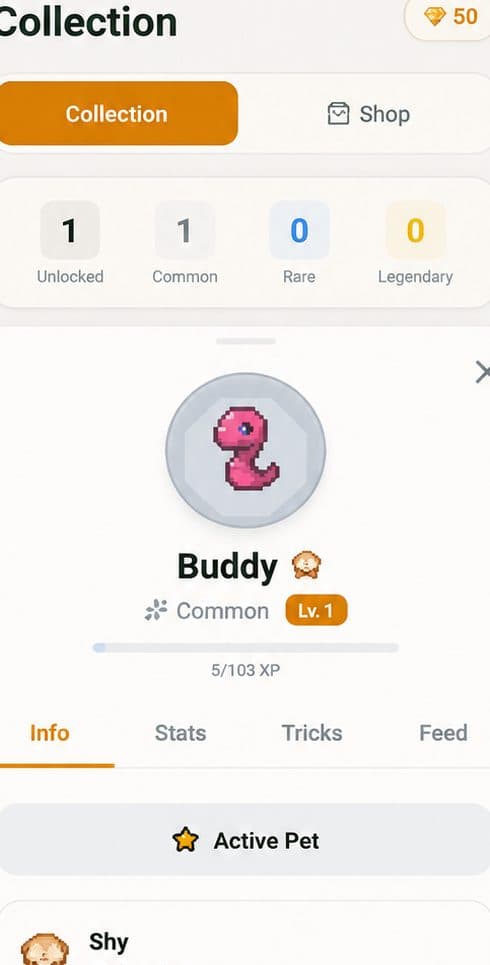
Nurrow is one example of this idea built into an actual app, not the only way to apply it. The mechanic is simple: finish a focus session and you have a chance at an egg, which hatches into a pet you keep. The chance isn't identical every time, and it isn't guaranteed on short sessions, which is the point. You know finishing helps your odds, but you don't know exactly what a given session will earn you until it's over.
What matters for the argument here isn't the specific odds or the pet collection itself, it's the timing. The reward lands right when the session ends, not at some future milestone you have to trust will still feel motivating months from now. That's the small, immediate, slightly uncertain payoff described above, applied to a real focus timer instead of left as an abstract idea.
Willpower and Rewards, Working Together
None of this replaces caring about the work. If a task matters to you, that still carries most of the weight, and no reward system substitutes for actually wanting to do the thing you set out to do. What a reward layer changes is what happens on the days your motivation is running low, which is most days, for most people. It gives you a smaller, closer reason to start the session even when the big reason feels too far away to feel right now.
Nurrow is free to start, with no account required to begin. A premium subscription is optional and unlocks extras like faster hatching and exclusive pets, but the core reward loop works the same either way. For the full mechanics behind eggs, shards, streaks, and pet rarities, see the full breakdown of Nurrow's reward system.
The Short Version
Willpower-only plans tend to fail at a predictable moment: when motivation dips and the goal is still too far away to feel real. Small, immediate, slightly uncertain rewards close that gap better than a distant payoff or a flat checkmark ever will. A productivity rewards app doesn't ask you to trust discipline alone, it gives you something closer and more concrete to work toward every single session, on top of whatever motivation you already brought to the table.
Keep Exploring
Frequently Asked Questions
Isn't a reward system gimmicky for serious work?
It can be, if the reward is the point instead of the work. The test is simple: does the system get in the way of the task, or does it just make you more likely to sit down and start? A well-built reward layer runs quietly in the background while you work and only pays out after you finish, which means it's supporting the task, not competing with it.
Does this replace intrinsic motivation?
No, and it isn't trying to. Caring about your work is still what gets the important things done well. Reward systems exist for the gap intrinsic motivation doesn't cover: the ordinary, low-stakes moments when you know a task matters but don't feel like starting it right now. A small immediate incentive is there to close that gap, not to replace the reason you took the work on in the first place.
How is this different from just checking off a to-do list?
A checkmark is a record, not much of a pull. It tells you a task is done after the fact, but it rarely makes the moment of finishing feel like anything. Reward-based systems add uncertainty and immediacy: you don't know exactly what you'll get, and you get it right when the session ends, both of which make the payoff more noticeable than a static checkbox.
Why would a small, uncertain reward work better than a big goal?
Big goals are real, but they're distant, and distant things are weak motivators in the exact minute you want to quit. A small reward attached to the task in front of you, right now, gives your attention something to hold onto today instead of asking you to run entirely on a payoff that's weeks or months away.
Will the novelty just wear off?
Any single reward can go flat with repetition, which is why variability matters more than the reward itself. A system that pays out the same way every time is easy to get numb to. One where the outcome shifts session to session, while the odds still improve the more you commit, tends to hold attention longer than a flat, predictable payout.
Ready to Start Focusing?
Nurrow is free to start, with no account required to begin. Download it today and put your next focus session to work.