A Focus App for ADHD That Works With Your Brain, Not Against It
Most productivity apps assume you'll stick around for the reward. Finish the project, then feel good. Clear the whole list, then relax. That works fine if delayed gratification comes naturally to you. For a lot of people with ADHD, it doesn't, and that gap is exactly why so many timers, planners, and to-do apps get downloaded, used for three days, and quietly abandoned.
Nurrow was built to close that gap. Instead of asking you to wait for a payoff, it gives you one at the end of every single session: an egg, a bit of progress on a pet you're raising, visible proof that the last chunk of time mattered. If you're looking for a focus app that treats immediate reward as a feature instead of an afterthought, this is what Nurrow does differently.
Why Delayed Rewards Don't Land the Same Way
A plain to-do app's reward is a checkmark, and the "real" payoff (the finished essay, the clean inbox, the passed exam) is often hours or days away. For ADHD brains, that distance matters a lot more than it does for other people. Interest and reward tend to drive follow-through more than importance or deadlines do, which is a big part of why a task can feel completely undoable at 2pm and then get finished in a sprint at 11:58pm the night before it's due.
Nurrow shortens that distance on purpose. You don't wait until the essay is done to feel like something happened. You feel it after 25 minutes, when an egg drops and your pet does something in response. The task itself hasn't changed, but the loop around it has.
Short Sessions Lower the Barrier to Starting
The hardest part of focusing usually isn't the work itself, it's the moment right before you start. "Write the essay" is a huge, fuzzy ask. "Sit for 25 minutes" is small and concrete enough that it's hard to argue yourself out of it. That's why Nurrow's default timer modes lean short: 25 minutes, not 90. A short session is easy to say yes to on a bad day, and once you're a few minutes in, momentum tends to take over on its own.
You can always stretch sessions longer once you're warmed up, but the app never makes the first ask a big one. Lowering that activation barrier is a bigger deal for follow-through than picking the "optimal" session length on paper.
A Worked Example: Writing an Essay
Say a student has an essay due and has been staring at a blank document for twenty minutes. They open Nurrow, pick the 25-minute timer, and hit start. Their blocklist kicks in immediately, so the group chat, the video app, and the news site they always drift to are simply unreachable for the next 25 minutes. There's nothing to resist because the option isn't there.
Ten minutes in, their attention wanders anyway (that's normal, not a failure) and they reach for their phone out of habit. The blocked apps stay blocked, so instead of falling into a scroll, they end up back on the document within a minute or two. They keep writing. When the 25 minutes run out, the session completes and an egg drops.
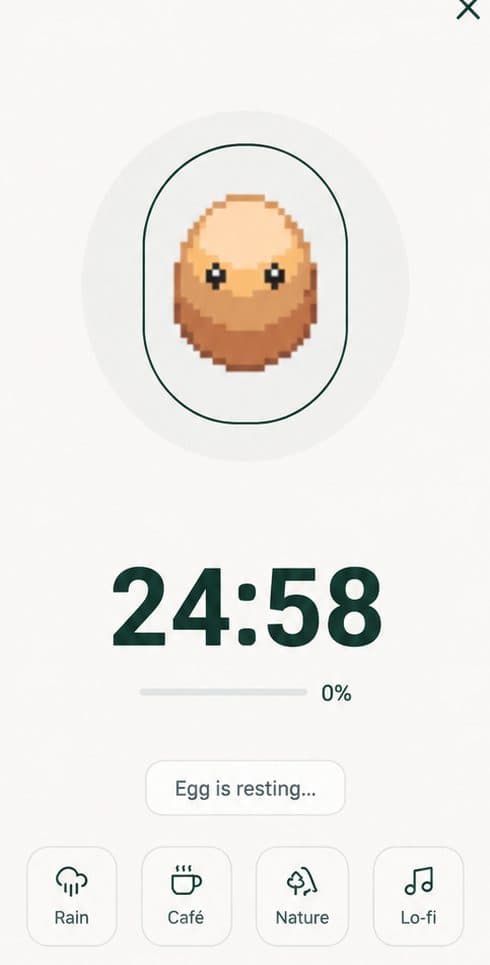
That egg is a small thing on paper, but it's proof of something that actually happened in the last 25 minutes, sitting right there on screen, not buried in a word count or a grade that's still days away. The essay isn't finished, but the student has a reason to start another session, because the next 25 minutes has its own payoff too.
Visible Progress as an External Motivator
A pet that hatches, grows, and levels up gives you something a plain progress bar can't: a reason to check back in. Progress bars are abstract. A pet you've been raising for two weeks is not. Watching it change in response to your focus time turns "I should probably work" into "I want to see what happens next," which is a much easier motivation to act on when your own internal drive isn't cooperating that day.
This is the core idea behind Nurrow's pet collection system: it externalizes progress that would otherwise be invisible. You don't have to trust that today's session mattered. You can see it.
Streaks as Light Accountability
Streaks work the same way, in a smaller dose. A visible counter that ticks up each day you focus is a gentle nudge, not a punishment system. Missing a day doesn't undo your pets or your history, it just resets the counter, so there's accountability without the all-or-nothing pressure that makes a lot of habit trackers feel worse than not using them at all.
What This App Is, and What It Isn't
Nurrow is a practical tool for building a focus habit: session timers, site blocking, and a reward loop that pays out sooner rather than later. It's free to start, with no account required to begin, and an optional premium subscription unlocks extras like faster hatching and exclusive pets if you want them. It is not a medical treatment, and it doesn't diagnose or manage ADHD. If you're navigating a diagnosis or treatment plan, that's a conversation for a doctor or therapist. Nurrow's job is smaller and more specific: make the next 25 minutes easier to start.
Keep Exploring
Frequently Asked Questions
Do I have to use the default 25-minute session length?
No. 25 minutes is just the starting point because it's a low enough commitment that it doesn't feel intimidating. You can shorten sessions to 10 or 15 minutes on hard days, or stretch them out once you're in a groove. There's no penalty for picking a shorter timer.
What happens if I get distracted and open a blocked site?
If a site is on your blocklist, it's simply inaccessible for the length of the session, so there's no moment of temptation to fight in real time. If you get pulled away some other way and close the app early, the session ends without a reward. Nothing bad happens beyond that: you can just start another one whenever you're ready.
Is Nurrow a substitute for ADHD medication or therapy?
No. Nurrow is a productivity and focus tool, not a medical device or treatment. It doesn't diagnose or treat ADHD or any other condition. If you're managing ADHD, please keep working with a qualified doctor or therapist. Nurrow is meant to sit alongside that care as a practical habit aid, not replace it.
Do I need to hit a streak every single day for it to work?
Not at all. Streaks are there as light, visual accountability, not a strict rule. Missing a day doesn't erase your pet collection or your progress. Think of the streak counter as a nudge, not a scoreboard you have to defend.
Why a pet instead of just a checklist or progress bar?
A checklist tells you what's left to do. A pet that hatches, grows, and reacts to your sessions gives you something to check on, which turns focus time into a small feedback loop instead of an abstract to-do item. That loop is the whole point for brains that respond better to visible, immediate outcomes than to distant ones.
Ready to Start Focusing?
Nurrow is free to start, with no account required to begin. Download it today and put your next focus session to work.