How to Focus With ADHD: A Practical Guide
By Aaron Wakely, Nurrow founder · July 19, 2026
Most focus advice is written for a brain that isn't yours. "Just make a to-do list" and "eliminate distractions" assume that planning ahead and staying on task are the hard parts. For a lot of people with ADHD, the hard part is actually starting, and then staying started once the initial burst of interest fades. This guide skips the generic advice and covers a handful of practical, behavioral strategies that tend to work with an ADHD brain instead of against it: body doubling, external timers, small task chunks, environment design, and immediate rewards.
None of this is medical advice, and none of it is a treatment plan. It's a set of habits and environmental tweaks that people commonly find useful. If you're managing a diagnosis, the right person to guide that is a doctor or therapist, not a blog post. Think of everything below as things you can try this week, not a protocol you have to follow perfectly.
Body Doubling: Borrow Someone Else's Presence
Body doubling is simply working next to another person, in person or over a video call, while each of you does your own task. Nobody is supervising anybody. The other person might be answering emails while you're writing a report, and that's fine. What matters is that you're visible to someone, which adds a light layer of social accountability that's surprisingly effective at keeping you in your chair.
If you don't have a friend free to sit with you, virtual body doubling works too: there are study-with-me streams, co-working calls, and apps built around this exact idea. The specific format matters less than the basic fact of someone else being present while you work.
Use an External Timer Instead of Relying on Willpower
Willpower runs out, and it runs out faster on days when you're tired, stressed, or just not interested in the task in front of you. An external timer takes the job of tracking time and deciding when to stop off your own head and hands it to a device. You're not negotiating with yourself every few minutes about whether to keep going; the timer is simply running.
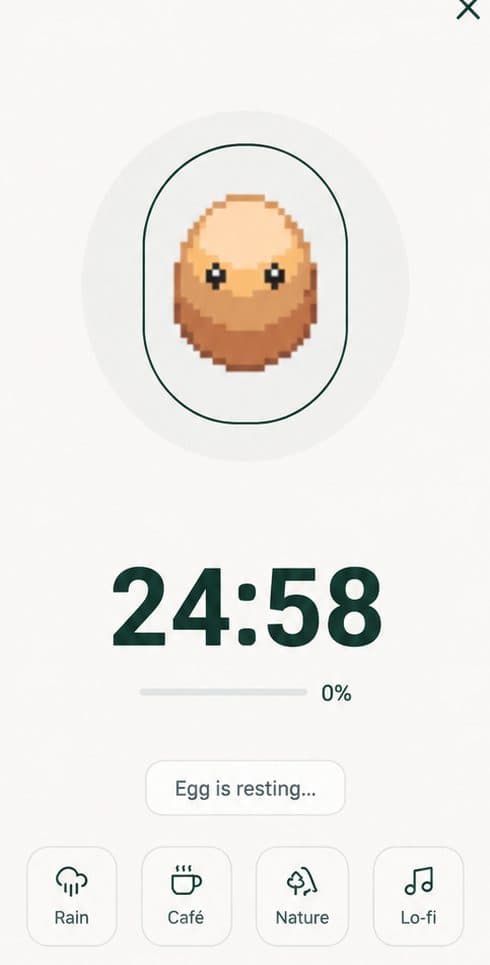
A basic kitchen timer works. So does your phone, as long as it's not also the source of your distractions. This is one of the few spots where Nurrow fits into this guide: it pairs an external timer with an immediate reward at the end of each session, which covers two of the strategies here at once. It's one tool among many that can do this job, not a requirement for any of it.
Break Work Into Small, Concrete Chunks
"Write the report" is vague enough to stall on for an hour before you've typed a word. "Write the first two sentences of the introduction" is small and specific enough that it's hard to talk yourself out of. The size of the first step matters more than people expect. A task that feels huge and undefined invites procrastination almost automatically, while a task you can picture finishing in ten minutes invites action.
Before you sit down to work, try turning the task into a list of steps small enough that each one feels almost too easy to skip. You can always keep going once you're moving. The goal of chunking isn't to make the whole project small, it's to make the next step small.
Design Your Environment So You Don't Have to Resist Anything
Resisting a distraction takes energy every single time it happens. It's much cheaper to remove the distraction once than to fight the urge to check it fifteen times during a work session. Before you start, close the extra browser tabs, put your phone in another room (not just face-down on the desk), and clear anything off your screen that isn't the task itself.
Reduce Task-Switching, Not Just Screen Time
Task-switching has a cost that's easy to underestimate: every time you bounce between an email, a message, and the actual assignment, you pay a small tax in lost momentum getting back to where you were. Try picking one task per session and deciding in advance that everything else waits. If a stray thought or to-do pops up mid-session, jot it on a sticky note instead of acting on it right away, so it doesn't derail the session you're already in.
Reward Yourself Immediately, Not Eventually
A lot of standard productivity advice assumes the "real" reward, like a finished project or a good grade, is enough to keep you going. For many ADHD brains, a payoff that's hours or days away doesn't carry much weight in the moment, which is part of why distant deadlines can feel weirdly unmotivating right up until they're suddenly urgent. Pairing each finished chunk of work with a small, immediate reward closes that gap: a snack, five minutes of a favorite song, a short walk, or, in Nurrow's case, an egg drop and a bit of visible progress on a pet.
The specific reward matters less than the timing. It should arrive right after the work, not at the end of the day or the end of the week.
Add Light External Accountability
Streaks, daily check-ins with a friend, or a visible tracker on your wall all do the same basic job: they make your progress (or lack of it) visible to something outside your own head. That external visibility tends to carry more weight than an internal promise to yourself, especially on days when motivation is low. The best accountability systems are gentle rather than punishing. A missed day should reset a counter, not undo everything you've built, or you'll be tempted to abandon the whole system the first time you slip.
Put It Together
None of these strategies need to be used all at once. Start with whichever one addresses your biggest sticking point right now. If starting is the hardest part, chunk the task smaller. If staying on task is the problem, try an external timer and a cleared-off environment. If motivation fades halfway through, add an immediate reward at the end of a short session. Small, repeatable changes tend to outlast big, ambitious overhauls, and you can always add another strategy once the first one feels automatic.
Keep Exploring
Frequently Asked Questions
What is body doubling, and does it actually help?
Body doubling means working alongside another person, in the same room or on a video call, even if they're doing completely different work. Neither of you is coaching the other. Just being visible to someone else adds a small amount of social accountability that makes it harder to drift off task. Many people with ADHD find it noticeably easier to start and sustain work this way, though it isn't magic and it won't work for every task or every person.
Are these tips a substitute for ADHD treatment or therapy?
No. This guide covers practical, behavioral strategies, not medical advice. It doesn't diagnose or treat ADHD or any other condition. If you have or suspect ADHD, the right next step is talking to a doctor or licensed therapist who can assess your specific situation. These strategies can sit alongside professional care, but they aren't a replacement for it.
How long does it take for one of these habits to stick?
It varies a lot by person and by habit, and there's no single reliable number that applies to everyone. What tends to matter more than the exact timeline is consistency and how low-friction the habit is to repeat. A habit you can do in under a minute (like putting your phone in another room before you sit down) tends to stick faster than one with a lot of setup.
Why do external timers work better than just trying harder?
Willpower is a limited, inconsistent resource, especially on days when sleep, stress, or interest levels are working against you. An external timer moves the job of tracking time off your brain and onto a device, so you don't have to keep re-deciding to stay on task every few minutes. It also creates a visible, external commitment: the timer is running whether you feel motivated or not.
What if I break my focus session early?
That's normal and not a sign you're doing this wrong. If a session falls apart, it's usually a sign the chunk of work was too big, the environment had too many open exits (extra tabs, a nearby phone), or the reward at the end wasn't immediate enough to feel worth it. Adjust one of those variables and try a shorter session rather than treating the interruption as a failure.
Ready to Start Focusing?
Nurrow is free to start, with no account required to begin. Download it today and put your next focus session to work.