The Pomodoro Technique: A Full Guide
By Aaron Wakely, Nurrow founder · July 19, 2026
The Pomodoro Technique is one of the most widely used time management methods around, and also one of the simplest: work for a fixed interval, take a short break, repeat. No app, no special equipment, no complicated rules. Just a timer and a willingness to work in blocks instead of open-ended stretches. Here's where it came from, how the classic version actually works, where people tend to go wrong with it, and how to adjust it if the default interval doesn't suit you.
Where the Pomodoro Technique Came From
Francesco Cirillo developed the technique in the late 1980s as a university student struggling to stay focused on his coursework. His solution was almost embarrassingly low-tech: he grabbed a kitchen timer shaped like a tomato and challenged himself to work for just ten minutes without stopping. That timer was Italian for tomato, pomodoro, and the name carried over once he refined the method and started teaching it to others. Today "a Pomodoro" is shorthand for a single completed work interval, whether or not you're using an actual tomato timer to track it.
What started as a personal fix for procrastination eventually became a published method with a small but consistent set of rules, and it's still one of the first things recommended to anyone struggling to sit down and start a task.
The Classic Structure
The original technique is built around a simple cycle:
- Work on a single task for 25 focused minutes.
- Take a short break, typically 5 minutes.
- Repeat that cycle four times.
- After the fourth interval, take a longer break, usually 15 to 30 minutes, before starting the next set.
That's the entire method. The 25-minute block is meant to be protected: no checking messages, no switching tasks, no "just a quick look" at something unrelated. If something urgent comes up, Cirillo's own advice was to jot it down and deal with it once the interval ends, rather than letting it break the block. The 5-minute break is a genuine pause, not a chance to answer emails or scroll a feed, since the point is to actually step away before the next interval starts.
Why the Interval Structure Tends to Work
There's no single definitive study that proves 25 minutes is a magic number for human attention, and it's worth being skeptical of anyone who claims otherwise. What the interval structure does reliably offer is something simpler: a task that felt too big or too vague to start suddenly has a small, concrete entry point. "Work for 25 minutes" is a much easier commitment than "finish this project," and once you're a few minutes into a Pomodoro, momentum tends to carry you the rest of the way.
The built-in breaks matter too. Working in long, unbroken stretches tends to lead to fatigue and a slow decline in the quality of attention over time, in a general sense that most people recognize from experience even without a citation attached to it. Regular short breaks give you a natural point to reset before that decline sets in, rather than pushing through until you're forced to stop anyway.
Common Mistakes People Make With It
Skipping the breaks
The most common mistake is treating the break as optional when you're "in the zone." Skipping breaks to keep momentum going defeats part of the purpose, since the break is what keeps the next interval from starting depleted. If you find yourself consistently wanting to skip the break because five minutes feels too short, that's usually a sign to lengthen both the work and break intervals, not to cut the break out entirely.
Not tracking what interrupts you
A single missed interval isn't a big deal. A pattern of the same interruption killing every interval is worth noticing. Cirillo's method includes jotting down interruptions as they happen so you can look back and see what's actually derailing your work: a specific app, a specific person, a specific time of day. Without that record, you're stuck guessing at why the technique "isn't working" instead of fixing the actual cause.
Treating 25 minutes as sacred
Twenty-five minutes is a starting point, not a law. Some tasks need more runway before you're actually productive, in which case a 25-minute block ends right as you're getting somewhere. Other tasks or brains do better with something shorter. Sticking rigidly to the default interval when it clearly doesn't fit the work is a common way people give up on the technique entirely, when the fix is usually just changing one number.
Adapting the Interval Length
The 25/5 split is a default, not a requirement, and adjusting it is often the difference between a technique that sticks and one that gets abandoned after a week. A few common variations:
- 50/10, for deep work. Tasks like writing, coding, or problem sets often take several minutes just to load into your head. A longer interval gives you room to actually settle in before the timer runs out.
- 15/5, for ADHD-friendly bursts. Shorter intervals with frequent breaks can work better when a full 25 minutes feels like too long a commitment to start, since both the payoff and the stopping point arrive sooner.
- 90/20, for single-task deep focus. Matched loosely to longer natural cycles of alertness, useful for exam prep or work that genuinely needs an extended, uninterrupted stretch.
There's no wrong answer here beyond the interval that keeps you from actually finishing tasks. Try a length, run it for a few days, and adjust based on whether you're consistently finishing intervals or consistently fighting them.
Running the Technique With an Added Motivation Layer
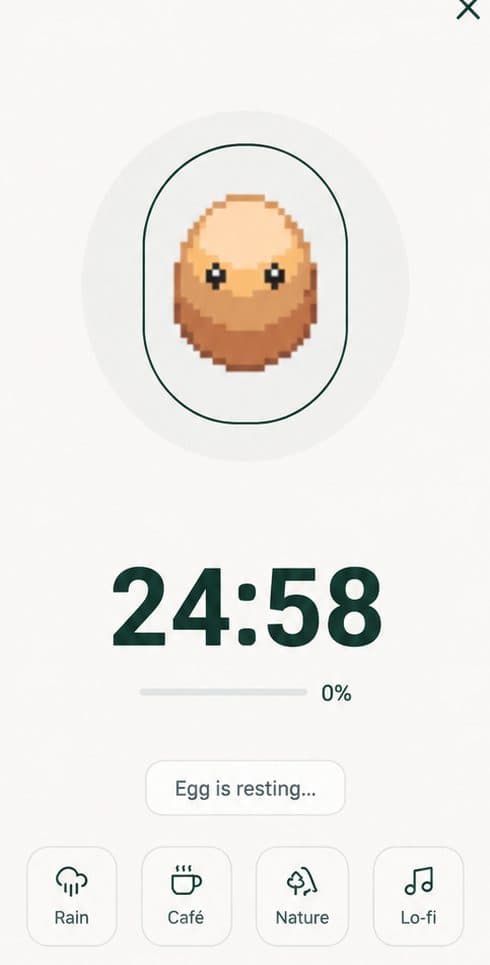
A plain kitchen timer, or the timer already built into your phone, handles the core mechanics of the Pomodoro Technique just fine. What it doesn't give you is much reason to protect the interval once the timer's novelty wears off, which is exactly where a lot of people quietly stop using it after a week or two. Apps built specifically around focus intervals, including Nurrow, keep the same interval structure described above but attach a small reward, in Nurrow's case a chance at hatching a virtual pet, to finishing each work interval. It's the same technique underneath, just with an added reason to actually see the timer through to zero. Nurrow is free to start, with no account required to begin, so trying it alongside whatever interval length you land on doesn't cost anything to test.
Keep Exploring
Frequently Asked Questions
Where does the name Pomodoro come from?
It's Italian for tomato. Francesco Cirillo, the university student who came up with the technique in the late 1980s, timed his study sessions with a kitchen timer shaped like a tomato. The name stuck, and now 'a Pomodoro' just means one completed work interval, regardless of what timer you actually use.
Is 25 minutes a mandatory interval length?
No. Twenty-five minutes is Cirillo's original default, not a rule. It's a reasonable starting point because it's short enough to commit to without much resistance, but plenty of people land on 50 minutes for deep work or 15 minutes for tasks that need more frequent breaks. The important part is a fixed work interval followed by a real break, not the specific number 25.
What do I do if something interrupts me mid-interval?
Cirillo's original guidance was to note the interruption and, if possible, defer it until the interval ends, then start the interval over if it derailed you completely. In practice, most people just make a quick note of what pulled their attention and get back to the task. What matters is noticing the pattern over time: if the same kind of interruption keeps showing up, that's worth solving separately from the timer itself.
Do I have to take the break?
You should. Skipping breaks to keep working defeats part of the point, the break is what keeps the next interval from starting on a depleted tank. If a five-minute break genuinely isn't enough after a hard interval, it's usually a sign you need a longer work/break ratio, not that breaks are optional.
Does the Pomodoro Technique work for ADHD brains?
It can, though the default 25/5 split isn't always the right fit. Shorter intervals (around 15 minutes) with frequent breaks tend to work better for some ADHD brains than the standard length, since the payoff and the stopping point both arrive sooner. The core structure, a fixed timer plus a real break, is flexible enough to adjust without losing what makes it work.
Ready to Start Focusing?
Nurrow is free to start, with no account required to begin. Download it today and put your next focus session to work.