Study Tips for ADHD Brains That Hold Up Past Page One
By Aaron Wakely, Nurrow founder · July 19, 2026
Most study advice assumes you can sit down, open a textbook, and grind through it until it's done. That assumption falls apart fast for a lot of ADHD brains, not because the material is too hard, but because sitting still with an open-ended task is genuinely difficult, no matter how much the exam matters. The fix isn't trying harder at the same approach. It's changing the shape of studying itself: shorter blocks, an external structure you don't have to enforce yourself, a study space with fewer things competing for your attention, and techniques that make the time you do spend actually count.
Study in short blocks, with a real break in between
A three-hour study session sounds efficient on paper. In practice, attention for most people, and especially for ADHD brains, doesn't hold steady for three hours straight, it spikes and drops. You'll get real work done in the first stretch, then spend the next hour rereading the same paragraph without absorbing it. Breaking the session into 15 to 25-minute blocks with a short break after each one keeps you working closer to your actual attention span instead of past it.
The break matters as much as the block. Get up, walk around, stretch, get water, anything that involves moving your body rather than staring at a different screen. A break spent scrolling a feed doesn't reset your attention, it just trades one draining input for another, and it tends to eat far more time than the few minutes you planned. A movement break resets you enough to sit back down for the next block instead of dreading it.
Use an external timer instead of trying harder
"Just focus" isn't a strategy, it's a hope, and it tends to fail at the exact moment you need it most. An external timer takes the decision of when to start and when to stop out of your hands, which removes a surprising amount of the friction. You're not negotiating with yourself every few minutes about whether now is a good time to check your phone, the timer is simply running, and the block ends when it ends.
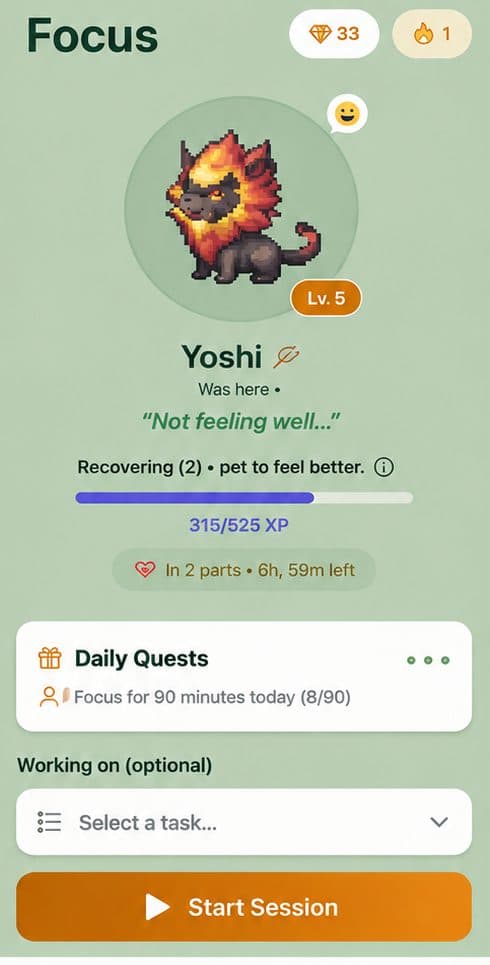
This is the specific piece where a tool like Nurrow can help: it's a timer with breaks built in, plus a small reward (an egg that can hatch into a pet) at the end of each completed session, so finishing a study block gives you something to see right away instead of just a vague sense that you probably studied. It's not the whole solution, just the timer-and-payoff part of it, but that part is often the piece people skip when they try to do this with willpower alone.
Cut your study space down to one task
Every open tab, notification, and visible phone is a decision point you have to resist, over and over, for the length of your session. Cut the number of decision points down before you start instead of fighting them one at a time:
- Put your phone in another room, not just face-down on the desk.
- Close every browser tab that isn't the one thing you're working from.
- Pick one study spot and use it consistently, so your brain starts associating that spot with working.
- Turn off notifications on whatever device you're using to study, even the "harmless" ones.
None of this requires more discipline. It requires fewer things to be disciplined about.
Active recall and spaced repetition beat rereading
Rereading notes feels productive because the information looks familiar as you go over it. Familiar isn't the same as known, though, and that gap tends to show up right when you can least afford it, in the middle of an exam. Active recall closes that gap: close the notes, and try to explain the concept, answer the question, or solve the problem from memory. It's slower and more uncomfortable than reading, which is exactly why it works, the struggle to retrieve something is what cements it.
Spread it out instead of cramming it in
Spaced repetition is the other half: reviewing material again a day later, then a few days after that, then a week later, rather than trying to learn it once and be done. Flashcards are the simplest version of this, physical or app-based, doesn't matter much. What matters is spacing the reviews out instead of reviewing everything the night before a test, since a single cram session tends to fade within days, while spaced review tends to stick around for the exam and after it.
Build a two-minute pre-study routine
The hardest part of studying usually isn't the studying, it's the moment right before you start, when the task is still huge and undefined in your head. A short, repeatable routine lowers that barrier by turning "start studying" into a series of small, automatic steps: sit at the same desk, put the phone away, open the right notebook or document to the right page, set the timer. None of that requires motivation, it's closer to muscle memory once you've done it enough times, and by the time the routine is finished, you're already sitting there with the material open, which makes the actual starting far less of a leap.
If you want to see how a timer, breaks, and a small reward loop fit together in practice, you can take a look at how Nurrow works on the homepage. The tool isn't the point, the structure is, but a tool that handles the structure for you makes it easier to actually keep doing.
Putting it together
None of these on their own will fix a bad study session. Stacked together, they cover most of what actually derails studying with an ADHD brain: sessions that are too long, no external structure forcing a stop or a break, a study space full of competing inputs, review techniques that feel productive but aren't, and a start-up cost that's high enough to talk yourself out of beginning at all. Fix those five things and the studying itself gets a lot more doable, even if the subject is still hard.
Keep Exploring
Frequently Asked Questions
How long should a study block be for an ADHD brain?
Somewhere between 15 and 25 minutes is a reasonable starting point for most people. It's short enough to commit to on a hard day, but long enough to actually get into the material. If you find yourself locked in and the timer goes off feeling too soon, let the next block run longer. If you're restless before it ends, shrink it further next time. The right length is whatever you'll actually sit down for, not whatever sounds impressive.
What if I can't get myself to start studying at all, even with a timer?
That's usually not a timer problem, it's an activation problem, and it happens before the timer is ever set. Try shrinking the first step until it's almost silly: open the textbook to the right page, or put your notes on the desk, without committing to actually reading anything yet. A two-minute pre-study routine you repeat every time (same spot, same playlist, phone away) also helps, because it removes the decision-making that usually stalls you out before you begin.
Do these tips replace medication, therapy, or other professional support for ADHD?
No. These are practical, behavioral study habits, not medical advice, and nothing here diagnoses or treats ADHD. If you're managing ADHD, keep working with a doctor or therapist; these tips are meant to sit alongside that care, not stand in for it.
Is rereading my notes really that bad?
Rereading isn't useless, but it's one of the least efficient ways to study, because recognizing information feels like knowing it, even when you'd struggle to produce it without the page in front of you. Active recall (closing the notes and trying to explain the concept from memory) is slower and more uncomfortable in the moment, but it's what actually tells you whether the material stuck.
Do I need a special app to study this way?
No, a phone timer and a notebook for flashcards will get you most of the way there. A timer app with built-in breaks and some kind of payoff at the end, like Nurrow, just makes the external-structure part easier to stick with, since you're not the one deciding when to start, stop, or get up.
Ready to Start Focusing?
Nurrow is free to start, with no account required to begin. Download it today and put your next focus session to work.