Time Blindness: What Helps
By Aaron Wakely, Nurrow founder · July 19, 2026
You sit down to answer "a couple of emails" and look up to find ninety minutes have gone by. You tell a friend you'll be ready in ten minutes, and it's twenty five before you're out the door, not because you were stalling, but because ten minutes genuinely felt like enough. A deadline sits on the calendar for two weeks feeling completely abstract, right up until the day before, when it suddenly feels like the only thing that exists. If any of that sounds familiar, you've experienced what's commonly called time blindness: trouble sensing time passing, estimating how long something will actually take, or noticing how much time is left before something is due.
It's often discussed alongside ADHD, but it's not exclusive to it, plenty of people who don't have ADHD describe the same pattern. This page isn't a diagnosis or a treatment plan for anything. It's a plain description of what the experience tends to feel like and a rundown of practical tools people commonly use to work around it.
It's Not About Not Caring
The most frustrating part of time blindness is usually how it reads to other people. Showing up late, missing a deadline you swore you'd hit, or losing an afternoon to a task that was supposed to take twenty minutes can look like carelessness or poor planning from the outside. From the inside, it's something else: the internal sense that most people lean on to feel time passing just isn't sending a clear signal. You're not choosing to ignore the clock. The clock isn't registering the way it does for someone whose internal sense of time works more predictably.
That distinction matters, because the fix isn't "try harder to notice time." It's building external systems that don't depend on noticing time at all.
Two Everyday Shapes This Takes
Losing Time While Absorbed
One common pattern is getting pulled into something, a task, a video, a conversation, and having the sense of elapsed time basically switch off. There's no gradual awareness that an hour has passed the way there might be for someone glancing at a clock every so often. Time just resumes all at once when something external interrupts it: a notification, a knock at the door, the room getting dark.
Misjudging How Long Things Take
The other common pattern is consistently underestimating task length, not occasionally, but as a default. A "quick" errand, a "short" email, a "five minute" tidy-up routinely take two or three times as long as predicted. It's not a math error so much as a missing feedback loop: without a strong internal sense of how fast time moves, estimating how much of it a task will eat is genuinely difficult, and the deadline-approaching feeling that would normally create urgency often doesn't arrive until very late, or not until the deadline has already passed.
Practical Tools People Use
Make Time Visible, Not Just Numeric
A digital clock reading "2:47" doesn't communicate much on its own, you have to do the work of subtracting it from whatever deadline you're tracking. A visual timer, something that shows a shrinking bar, a draining circle, or a countdown you can watch move, gives you that information for free. You don't have to calculate how much time is left; you can just look at it. That small shift, from a number you interpret to a shape you can see change, is one of the most commonly recommended tools for this.
Set Alarms and Reminders in Advance
Because the in-the-moment sense of "I should check the time now" is exactly the thing that's unreliable, it helps to decide when you'll need a nudge before you start, rather than trusting yourself to remember mid-task. A phone alarm set for "leave in 20 minutes" or a reminder that fires an hour before a meeting does the noticing for you, ahead of time, so nothing depends on your attention catching it in the moment.
Check In With Time at Set Intervals
Instead of trying to maintain a constant internal sense of how much time has passed, some people find it easier to build in deliberate check-in points: glance at the clock every fifteen minutes on the dot, or pause between tasks specifically to ask "how much time is actually left." It replaces a continuous, unreliable sense with a scheduled, repeatable habit.
Body Doubling
Working alongside another person, in the same room or on a call, can also help anchor a sense of time passing, since someone else's presence and pace gives you an external reference point. It's a technique worth its own explanation, so see our full guide to body doubling for more on how it works and how to try it.
Where an App Like Nurrow Fits In
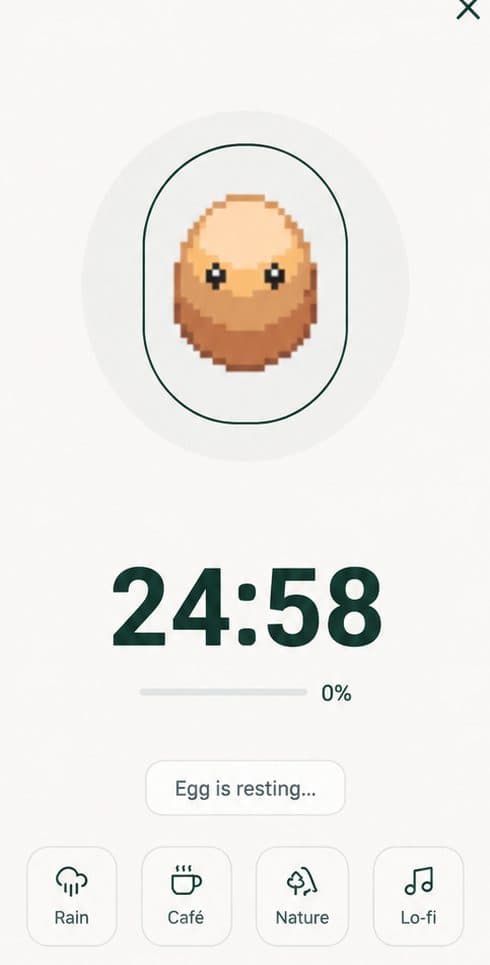
Nurrow is a focus timer built around growing a small virtual pet during each work session, and one side effect of how it's built is that it keeps a visible countdown on screen the entire time you're working. That's not a special fix for time blindness, it's the same "make time visible" idea covered above, just built into a timer you're already using for a session. It's one option among the tools already listed here, not a replacement for any of them, and it works best alongside the same habits: setting alarms in advance, checking in at intervals, or pairing a session with body doubling if that helps you.
Whatever tool you land on, the underlying idea is the same: stop trying to fix an unreliable internal clock, and build an external one you can actually see.
Keep Exploring
Frequently Asked Questions
What does time blindness actually feel like day to day?
It shows up in a few recurring ways: getting absorbed in something and looking up to find that an hour vanished with no sense of it passing, guessing that a task will take twenty minutes and having it take two hours, or not feeling any internal pull toward a deadline until it's suddenly right on top of you. It's less about a single symptom and more about time not registering the way a clock does: steadily and evenly.
Do visual timers actually help, and why?
Many people find they do, because a visual timer turns time into something you can see rather than something you have to remember to think about. A shrinking bar or a countdown you can glance at replaces the internal sense of time passing with an external one, so you're not relying on a sense that isn't giving you reliable signal in the first place.
Does time blindness only affect people with ADHD?
No. Time blindness is commonly discussed alongside ADHD, but plenty of people who don't have ADHD describe the same experience: losing track of time while focused, misjudging how long things take, or missing the feeling of a deadline approaching. This page is written for anyone who recognizes that experience, not just one diagnosis.
Is there a way to just get better at estimating time?
Some people find that keeping a rough log of how long tasks actually took, compared to how long they guessed, helps recalibrate over time. But most of the practical relief comes from working around the issue rather than trying to fix it directly: external timers, alarms, and scheduled check-ins that don't depend on your internal sense of time at all.
Is this page giving medical or diagnostic advice?
No. This is a practical, descriptive guide to a commonly experienced difficulty with sensing time, not a diagnostic tool or a treatment plan. It doesn't identify or treat any condition. If you're concerned about how this affects your daily life, a doctor or licensed professional is the right person to talk to.
Ready to Start Focusing?
Nurrow is free to start, with no account required to begin. Download it today and put your next focus session to work.