How to Stop Procrastinating (Without Relying on Willpower)
By Aaron Wakely, Nurrow founder · July 19, 2026
Most advice on how to stop procrastinating starts from the wrong assumption: that you're lazy, undisciplined, or just need to want it more. That framing doesn't match how procrastination actually works, and it's part of why so much advice fails to stick. Procrastination is rarely about not caring. It's usually about a task feeling unpleasant, confusing, or overwhelming right now, combined with a brain that's bad at weighing distant consequences against immediate discomfort. Once you see it that way, the fix stops being "try harder" and starts being a handful of specific, testable techniques.
Procrastination Is Task Aversion, Not Laziness
When people put off a task, it's almost never because the task doesn't matter to them. It's because starting the task carries some kind of immediate cost: boredom, confusion about where to begin, fear of doing it badly, or just the friction of switching away from something easier. Your brain treats that immediate, certain discomfort as more urgent than a distant, uncertain consequence, even when the consequence is much bigger. That's task aversion, and it explains why you can procrastinate on something you genuinely want to finish.
The practical upshot is that "just do it" isn't useful advice, because it doesn't touch the actual mechanism. What works instead is lowering the immediate cost of starting, or raising the immediate payoff, so the trade your brain is making looks different.
Present Bias: Future You Is a Stranger
There's a related effect worth naming directly: present bias. Humans consistently discount the value of future rewards and future costs compared to identical rewards and costs happening right now. Some researchers describe it as your brain treating "future you" almost like a different person, one whose problems feel less real than your own in this exact moment. That's why it's so easy to hand tomorrow-you a deadline crunch in exchange for an easier today. You're not being reckless; you're running on a bias that every human brain shares to some degree.
Knowing this doesn't make the bias disappear, but it does change the strategy. Instead of trying to out-argue your own brain about what matters more, the more reliable move is to shrink the gap between effort and reward so present-you gets something out of starting, too.
The 2-Minute Rule: Lower the Bar Until It's Silly Not to Start
The 2-minute rule is simple: commit to doing a task for just two minutes. Not finishing it, not making meaningful progress on it, just starting it. Open the document. Put on your running shoes. Write the first line. Two minutes is short enough that almost nobody can talk themselves out of it, and it sidesteps the actual source of procrastination, which is usually the size and vagueness of "starting," not the task itself.
The trick behind why this works is momentum. Once you're two minutes in, the task has already stopped being an abstract, intimidating thing and become a concrete thing you're partway through. A lot of the time, you'll keep going well past the two minutes. When you don't, that's fine too. You still moved the task forward and broke the standstill, which is the actual goal.
Temptation Bundling: Pair the Boring Task With Something You Want
Temptation bundling means attaching something you enjoy to something you've been avoiding, so the two only happen together. Only listen to your favorite podcast while doing the dishes. Only watch your comfort show while on the treadmill. Only let yourself play music you love during the boring parts of a work session. The enjoyable activity effectively subsidizes the unpleasant one, making the whole package feel worth starting.
For this to work, the bundle has to be a real trade-off, not two things running in parallel that compete for your attention. If the enjoyable half is engaging enough to fully hijack your focus (a gripping show instead of a podcast, for instance), it stops being a bundle and starts being a second distraction.
Implementation Intentions: Decide the "When" and "Where" in Advance
An implementation intention is a specific plan in the format "when X happens, I will do Y, at Z." Instead of "I'll work on the presentation sometime this week," it's "at 8am tomorrow, at my kitchen table, I'll open the slides and write the outline." The difference matters because a lot of procrastination happens in the gap between deciding you should do something and actually deciding it's time to do it right now. An implementation intention closes that gap ahead of time, so there's no in-the-moment negotiation left to lose.
Shrink the First Step Until It's Almost Embarrassingly Small
If a task keeps getting pushed off, the first step is probably still too big or too vague. "Study for the exam" isn't a step, it's a category. "Open the textbook to chapter four" is a step. Keep shrinking until the first move feels almost too small to count as procrastinating on, like opening a file or writing a single sentence. A step that small has almost no aversion attached to it, which is exactly the point.
Making the First Move Easier to Actually Start
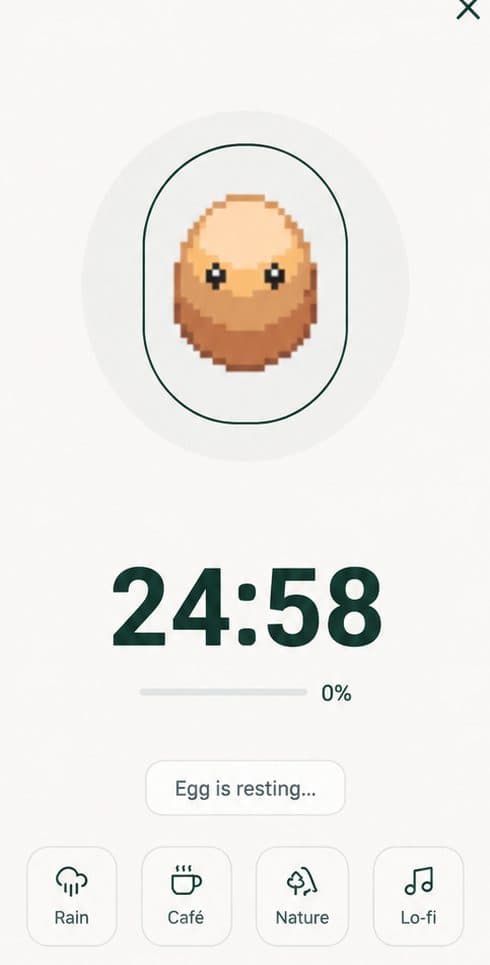
All of these techniques share the same underlying goal: lower the activation energy required to begin. A short timer paired with an immediate, visible reward does that job well, since it turns "start the task" into "start a short timer," which is a much smaller ask. That's the idea behind Nurrow, a focus app that runs a short session and gives you an immediate payoff (progress on a virtual pet) the moment it ends, rather than making you wait for the "real" reward of a finished project. It's one low-friction way to get moving, not a requirement for any of the techniques above, and it's free to start with no account required to begin.
None of these methods need to be used all at once, and none of them require you to feel motivated before you start. Pick whichever one matches your biggest sticking point this week, whether that's the size of the first step, the distance between effort and reward, or the vagueness of "later," and treat the rest as tools to reach for once the first one starts working.
Keep Exploring
Frequently Asked Questions
Why doesn't willpower alone fix procrastination?
Willpower is a limited, fluctuating resource, and procrastination usually isn't a willpower problem in the first place. It's driven by task aversion (the task itself feels unpleasant, confusing, or boring) and present bias (your brain undervalues rewards that are far away). Gritting your teeth and trying harder doesn't change either of those two forces. Changing the task, the environment, or the timing of the reward tends to work better than sheer effort.
What if I can't even manage the 2-minute version of a task?
Shrink it further. If two minutes still feels like too much, the step is still too big or too vague. Instead of "start the report," try "open the document and write one sentence," or even "open the document." There's no step too small to count. The goal is just to break the standstill, not to make meaningful progress on the first try.
Is chronic procrastination a sign of something deeper, like ADHD or anxiety?
Sometimes, but not always, and this article can't diagnose that for you. Occasional procrastination on tasks you find boring or intimidating is a normal, near-universal experience. If procrastination is severe, constant, and seriously affecting your work, school, or relationships, it's worth talking to a doctor or therapist, since it can overlap with ADHD, anxiety, depression, or perfectionism. A professional can look at your specific situation in a way a blog post never can.
Does temptation bundling actually work, or does it just create a new distraction?
It works when the enjoyable thing is genuinely tied to the task, not just happening near it. Listening to a podcast you love only while folding laundry is temptation bundling. Watching a show on a second monitor while you're supposed to be writing is just two things competing for your attention, and the show will usually win. The pairing has to make the boring task easier to tolerate, not give you an excuse to avoid it.
How is an implementation intention different from a normal goal or to-do item?
A goal says what you want to happen ("I'll work on my thesis this week"). An implementation intention says exactly when, where, and how you'll start ("At 9 a.m. Tuesday, at my desk, I'll open the thesis file and write the outline for section two"). The second version removes the in-the-moment decision of whether now is the right time, which is often the exact moment procrastination sneaks in.
Ready to Start Focusing?
Nurrow is free to start, with no account required to begin. Download it today and put your next focus session to work.