A Deep Work App Won't Save You (But It Helps)
By Aaron Wakely, Nurrow founder · August 9, 2026
"Deep work" has become a product category, which is a little ironic for an idea whose whole point is that concentration is a practice, not a purchase. The practice, long stretches of undistracted work on things that are hard, is what produces the results. What an app can honestly do is make the practice cheaper to sustain: fewer exits available in the weak moment, and a reason to finish the block you started. Here's what the practice actually requires, and where Nurrow fits.
What Deep Work Actually Requires
- A defined block. Deep work is scheduled, not hoped for. An open-ended "I'll work on it today" reliably becomes shallow work; a 90-minute block with a start and an end reliably doesn't.
- Closed exits. Depth builds over minutes and collapses in seconds. The distracting sites don't need to be gone forever, just unreachable for the length of the block.
- A reason to repeat it. One deep session is an event; the returns come from the habit. Streaks, visible stats, and a reward at the end of each block are what carry the practice past week one.
How Nurrow Maps Onto That
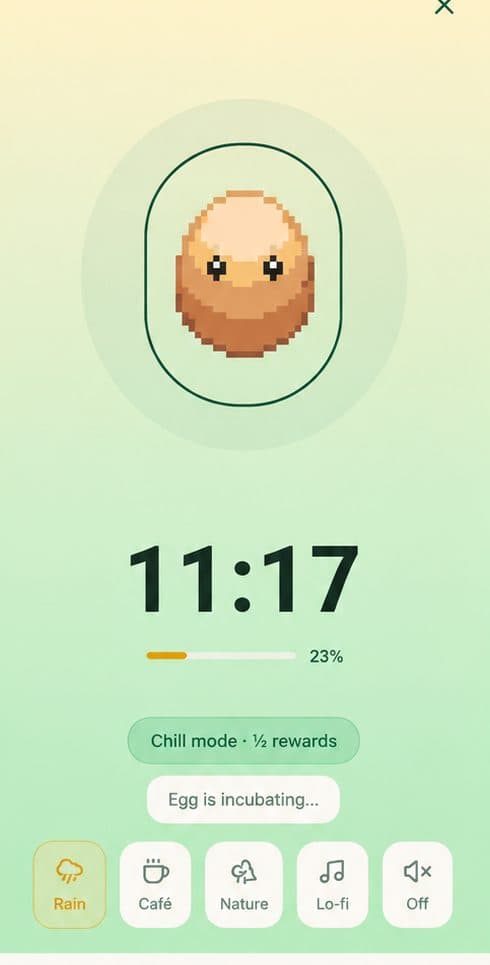
Nurrow's focus sessions are the block: pick a length, start the timer, and the sites on your blocklist stop loading until it ends. Finishing earns progress toward eggs and the pet collection, and your streak builds day over day, which is the repeat-tomorrow mechanism. It's free to start on Android and iPhone with no account required. And for the days when a blocklist isn't strict enough, a full Deep Work mode is in the works that inverts the model, blocking everything except an allowlist you set in advance, with deliberate friction against backing out early (the mechanics are described in the Deep Work mode docs).
A Realistic Deep Work Routine
- Pick tomorrow's one deep task tonight, so the block starts with zero deciding.
- Schedule one 50–90 minute session at your best hour, for most people that's the morning, before the shallow work starts.
- Start the session with blocking on and your phone's notifications silenced (Do Not Disturb does the half an app can't).
- When the timer ends, stop, even mid-momentum. Stopping while it still feels good is what makes tomorrow's block easier to start.
- Add a second daily block only after two weeks of hitting one. Volume follows consistency, not the other way around.
The Honest Caveat About Tools
No app makes the work itself easier, deep work is hard because thinking is hard, and it stays hard. What the right tool changes is everything around the hardness: the start (a timer beats a vague intention), the middle (a block beats willpower), and the end (a reward beats nothing). If you're building the practice from scratch, pair this with the Pomodoro guide for interval basics, and treat any app, ours included, as scaffolding for the habit rather than the habit itself.
Keep Exploring
Frequently Asked Questions
What counts as deep work, and what doesn't?
Deep work, the term popularized by Cal Newport, is cognitively demanding work done in a state of distraction-free concentration: writing, coding, studying for mastery, solving hard problems. What doesn't count is the shallow layer around it, email, chat, admin, and anything done while half-checking another tab. The defining test isn't the task, it's the absence of context-switching while you do it.
Do I actually need an app for deep work?
Strictly, no, deep work predates smartphones. What an app changes is the cost of failure. Without one, a single impulse ('I'll just check one thing') silently ends a deep work block. With session-based blocking, that impulse hits a wall instead of a feed, and with a reward loop attached, finishing the block earns something. The app doesn't do the deep work; it protects the conditions for it.
How does Nurrow support deep work today?
With timed focus sessions and website blocking: you set a session length, the sites on your blocklist become unreachable until the timer ends, and finishing earns egg and pet progress plus streak credit. For deep work specifically, longer sessions matter, a 90-minute block with your worst sites blocked covers most people's realistic deep work capacity for a morning. Nurrow also has a stricter allowlist-only Deep Work mode in the works, which flips blocking around so everything is blocked except sites you approve in advance.
How long should a deep work session be?
Longer than a Pomodoro, shorter than you think. Newport suggests most people new to the practice max out around one to four hours of true deep work per day, built up gradually. Starting with 50 to 90 minute blocks is realistic; a 25-minute Pomodoro is often too short to reach depth on hard problems, though it's a fine on-ramp if longer blocks keep failing. The honest metric is how long you can go without wanting to switch, then a little longer.
Is deep work realistic with ADHD?
Yes, but the standard advice needs adapting. Long unstructured blocks are often exactly wrong; what tends to work is externalized structure, a visible timer, blocking that removes the negotiation, an immediate reward at the end, and shorter blocks repeated rather than one heroic stretch. That structure is essentially what Nurrow's session loop provides, and our ADHD-specific guides cover the rest of the toolkit.
Ready to Start Focusing?
Nurrow is free to start, with no account required to begin. Download it today and put your next focus session to work.